
RPMflex products
- RPMflexMulti-company ERP for service companies. Integrates sales, projects, tasks, hours and finance.
- RPMsqlSecure, read-only access to RPMflex data for Power BI, Excel, AI and integrations.
- RPMfinAccounts payable, receivable and cash flow for MEIs and small businesses, on your phone or computer.
- RPMlocEquipment rental system, with control of rentals, maintenance and finance.
- RPMvetOrganize scheduling, appointments, records, vaccines and finance, with automatic reminders.
- RPMconNewManage contracts, templates, owners, due dates and adjustments, with digital signature.
Log in
Select the app from the options below
- ERPIdeal for directors, managers and sales, finance and administrative teams. Full or user-customized access.
- TimesheetRecord activities, hours and expenses. Ideal for consultants, engineers, analysts, developers and other delivery teams.
- iClientClient portal to open tickets, track projects and tasks and view the hours logged by the team.
- What is a Timesheet?
- Why is the timesheet so important for technology, engineering and consulting companies?
- What data can a good timesheet generate?
- How does time tracking work across projects, tasks and tickets?
- Timesheet integrated with finance: why does it make such a difference?
- Automation for billing hours worked
- Paying employees who are paid by the hour
- Financial results by project and by customer
- Time-tracking app: why does it increase adoption?
- How to choose timesheet software
- How RPMflex supports hour control and financial management of projects
- Frequently asked questions about timesheets
- Want to see in practice how the timesheet can support your projects and finances?
Project Management • Timesheet • ERP for Services
Understand what a timesheet is, how time tracking works across projects, tasks and tickets, and why integrating it with finance is decisive for technology, engineering and consulting companies.
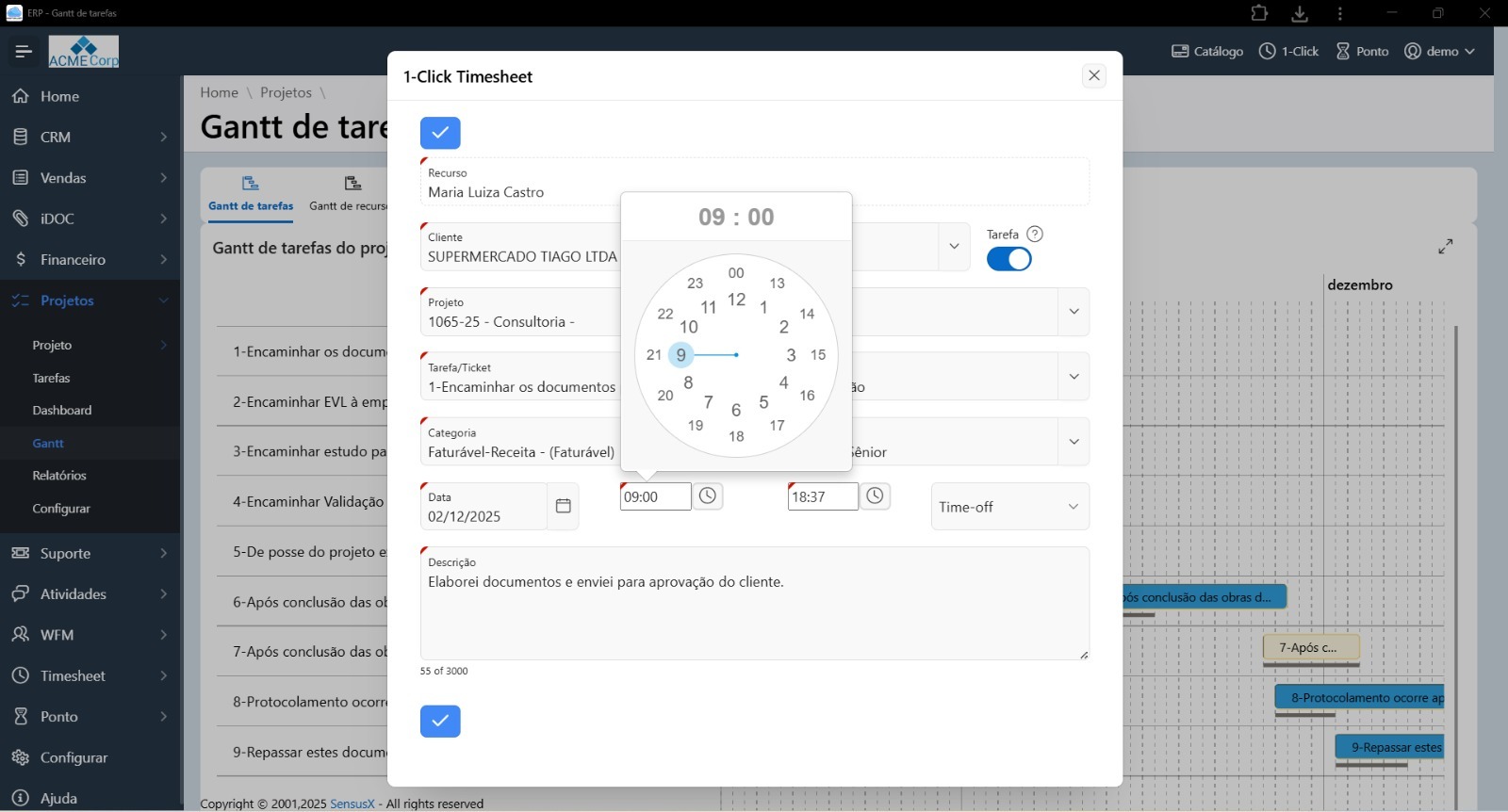
Example of time tracking in RPMflex, focused on convenience, traceability and integration with operations.
In this article you will see:
- What a timesheet is and how it works
- The difference between timesheet, time tracking and hour logging
- Why service companies need to control hours precisely
- How to use logged hours for billing and hourly pay
- How to calculate financial results by project and by customer
- What to look for in timesheet software with an app
What is a Timesheet?
A timesheet is the record of hours worked by team member, project, task, ticket, customer or activity. It is also commonly called time tracking or hour logging.
In practice, the timesheet shows who worked, on what, for how long and for which customer or project. This record is fundamental for companies that sell time, technical knowledge, task execution or specialized support.
More than controlling hours, a good timesheet helps turn operational effort into strategic information on productivity, costs, billing and margin by project.
Are timesheet, time tracking and hour logging the same thing?
In most contexts, yes. The term time tracking is more often used in international tools. Timesheet and hour logging ("apontamento de horas") are very common expressions in the Brazilian market, especially in technology, engineering, consulting and recurring-services companies.
Why is the timesheet so important for technology, engineering and consulting companies?
In service companies, the main cost is usually not raw material. It is the team's time. So when hours are not recorded correctly, the company loses visibility into what is really happening in the operation.
Without a reliable timesheet: imprecise estimates, billing errors, invisible rework and difficulty knowing whether a project is profitable.
With an integrated timesheet: more control over effort, productivity, costs, revenue and financial results by project or customer.
This is especially relevant when the company needs to:
- bill customers for hours worked
- measure effort by task, project or ticket
- track technical and advisory teams
- pay employees or contractors by the hour
- analyze margin by project, contract or customer
What data can a good timesheet generate?
When hours are logged consistently, the manager stops working on gut feeling and starts deciding based on concrete data.
1. Real distribution of time
You understand where the team is investing effort: in projects, support, internal tasks, meetings or rework.
2. Estimated vs. actual
Comparing what was planned with what actually consumed hours helps improve schedules, proposals and pricing.
3. Capacity and workload
It becomes easier to identify overload, idle time, bottlenecks and the need to redistribute tasks.
4. Cost by project and by customer
Logged hours can be converted into cost, showing the real weight of the operation in each deliverable.
5. Financial results by project
When the timesheet is connected to finance, the company can assess revenue, cost and margin much more precisely.
In other words: the timesheet stops being merely operational and becomes a central piece of financial management and profitability.
How does time tracking work across projects, tasks and tickets?
Ideally, logging happens as close as possible to the actual execution of the work. This increases accuracy and reduces forgetting.
- The team member carries out an activity
- Logs the hours on the corresponding project, task or ticket
- The system consolidates this effort by person, team, customer and project
- The data feeds reports, costs, billing and performance indicators
What should be linked to a time entry?
- project
- customer
- task or stage
- ticket or service request
- type of activity
- responsible team member
The more connected the timesheet is to the operational routine, the more reliable the information.
Timesheet integrated with finance: why does it make such a difference?
Many companies do record hours, but keep that information isolated in spreadsheets or separate systems. This limits the strategic value of the timesheet.
When the timesheet is integrated with finance, hours stop being just an operational history and directly influence:
- project costs
- billing of hours worked
- financial results by project
- payment of employees paid by the hour
- margin and profitability analysis
Companies that bill by the hour or by technical effort gain much more precision when time tracking automatically feeds the billing base.
Practical example
Imagine a consultancy that delivers a monthly package of hours to a customer. If hours are logged on tasks and tickets throughout the month, the system can automatically consolidate consumption, support billing and show whether that contract is generating a healthy margin.
Automation for billing hours worked
One of the biggest gains of a modern timesheet is automation. Instead of consolidating hours manually at the end of the month, the company can turn recorded effort into a billing base.
With that, you can:
- reduce billing errors
- avoid administrative rework
- bill faster
- have traceability of what is being charged
- give the customer more transparency
For engineering, technology and consulting companies, this is particularly relevant when the contract involves technical hours, hour banks, maintenance, support, implementation, service desk or recurring activities.
Paying employees who are paid by the hour
The timesheet is also important internally. In operations with hourly professionals, contractors, consultants or teams with variable pay by the hour, reliable time control is essential.
With a good system, it is possible to:
- consolidate hours by team member
- identify hours by project or cost center
- support payment calculations
- reduce discrepancies and disputes
- keep an auditable history of time entries
Financial results by project and by customer
This is one of the most valuable points for management. When the timesheet is connected to projects and finance, the company sees not only hours consumed, but the real financial result of the operation.
This makes it possible to answer strategic questions such as:
- which project is consuming more effort than it should?
- which customer demands more hours than the contract pays for?
- which activities generate more cost and less return?
- which team is most efficient in delivery?
For service companies, controlling hours without relating them to finance is seeing only half of the operation.
Time-tracking app: why does it increase adoption?
One of the biggest challenges of the timesheet is team engagement. The more bureaucratic the entry, the greater the chance of delays, forgetting or inaccurate records.
That is why ease of time tracking through an app makes a difference. It helps record time at the moment the work happens.
Advantages of logging via app
- more convenience day to day
- quick entry of hours
- less dependence on spreadsheets
- more accurate records
- greater adherence by the team
In operations with professionals allocated at the customer's site, in the field, in external meetings or frequently on the move, this feature becomes even more important.
How to choose timesheet software
Not every time-tracking tool serves service companies well. Before deciding, it is worth evaluating some essential criteria:
1. Ease of use
If the system is complicated, the team will not log hours consistently.
2. Integration with projects, tasks and tickets
Ideally, logging happens within the operational flow, not in a separate environment.
3. Integration with finance
This point is decisive for turning hours into cost, billing and results by project.
4. View by customer and by project
The system must allow management analysis, not just raw records.
5. App and mobility
The convenience of logging directly influences the quality of the data.
How RPMflex supports hour control and financial management of projects
RPMflex was developed for service companies that need to connect operations and results. That is why time tracking is not isolated: it is part of integrated management.
With RPMflex, your company can:
- log hours on projects, tasks and tickets
- log time more easily on web and app
- integrate hours with finance
- support billing automation based on hours worked
- track cost and financial results by project and customer
- gain more visibility for technology, engineering and consulting operations
In practice, RPMflex helps turn the timesheet into a tool for management, productivity, billing and profitability.
Frequently asked questions about timesheets
What is a timesheet in projects?
It is the record of hours dedicated to activities, tasks, tickets and projects, making it possible to control effort, costs and productivity.
What is the difference between timesheet and time tracking?
In practice, the two terms are usually used as equivalents. Both refer to the control and recording of working time.
Why integrate the timesheet with finance?
Because it allows hours to be turned into cost, billing, margin and financial results by project or customer.
Is a timesheet useful for tickets and support?
Yes. Logging hours on tickets helps control effort by service request, contract, SLA and customer.
Can a timesheet be used for hourly pay?
Yes. A reliable timesheet can support the consolidation of hours worked to calculate payments for hourly professionals or contractors.
Want to see in practice how the timesheet can support your projects and finances?
If your company needs to control hours on projects, tasks and tickets, automate billing and see financial results by project, RPMflex can help.
Take the next step
Fewer spreadsheets. More control. More profitability.
RPMflex integrates sales, projects, time tracking and finance on a single platform — from sale to billing.
Start now, no commitment.